
RIA Water Damage Restoration in East Bronx: A Homeowner’s Guide
The RIA’s S500 standard runs more than 200 pages, but the single number most East Bronx homeowners never ask for is the final equilibrium moisture content reading. That one figure, logged on the last day of drying, is the only real proof the job is finished and the walls won’t grow mold six months from now. If your restorer can’t show you that number in writing, the drying job was never verified to the standard, regardless of how dry the plaster feels to the touch. If you’d rather skip the homework and have us handle it, call (607) 602-2791 and we’ll walk you through exactly what we’d check.
What RIA Certification Actually Means (and What It Doesn’t)
The Restoration Industry Association sets the standards, but the credentials that matter on a wet Bronx floor are issued through the IICRC: Water Restoration Technician (WRT), Applied Structural Drying (ASD), and Applied Microbial Remediation Technician (AMRT). Each one authorizes a technician to do something specific.
Here’s the plain version of what those letters allow:
– WRT covers extraction and the initial drying setup. It means the tech understands how water moves through drywall, hardwood, and concrete.
– ASD goes deeper into psychrometry, the science of moving air and controlling humidity to hit drying targets. Without this, a crew is guessing.
– AMRT covers mold and sewage contamination. It’s required training for anything involving Category 3 water or visible microbial growth.
We’ve watched homeowners in Pelham Bay and Morris Park nod politely when a crew flashes a business card with “certified” printed on it. That word means nothing by itself. The IICRC maintains a public registry where you can look up any technician or firm by name. If the restorer standing in your kitchen can’t be found on that registry, they aren’t certified. Period.
A word about East Bronx specifics: many of our local rowhouses are balloon-frame construction, meaning wall cavities run continuously from basement to attic with no fire blocking. Water in a first-floor wall can wick up three stories in 48 hours. That’s not a suburban slab house problem. It requires more monitoring days, more air movers, and a restorer who actually understands why the drying is taking longer than a textbook case.
The Psychrometric Log You Should Demand on Day One
The S500 standard doesn’t just say “dry the house.” It sets specific targets for temperature, relative humidity, and airflow, and it requires the restorer to measure and record those numbers daily until the structure reaches a defined dry standard. Those daily records go by a few names: drying log, moisture log, psychrometric log. Whatever it’s called, you should see it.
Here’s what an RIA-compliant drying log in the East Bronx should contain:
– Initial moisture readings from every affected room, taken with a penetrating moisture meter, not just an infrared camera showing surface temperature differences.
– Daily readings from the same marked locations, so you can watch the numbers fall. A restorer who can’t produce a day-three reading for the same spot they marked on day one didn’t do the work.
– Drying goal calculations based on the building material, the class of water intrusion, and the local climate. Riverdale near the Harlem River and Throggs Neck near the Sound have different ambient humidity than a dry inland suburb.
– Final equilibrium moisture content (EMC) for every structural material. Wood typically needs to get below 15% moisture content. Drywall below 12%. Plaster lath in a 1920s rowhouse can hold water differently than modern gypsum board.
A restorer who uses RIA documentation to protect their own liability will file the log and never show you. The company that hands you the log on the final day, with the numbers and the dry standard met, is using documentation as a workmanship guarantee. That distinction matters enormously in a market like the East Bronx, where older homes with plaster walls and shared party walls make drying harder and take longer than textbook timelines suggest.
When we quote a job, you get a written scope and a moisture log that you keep. No arguing, no “trust us.” The numbers are there in black and white. That’s the Keystone Standard behind our 90-Day Done Right Promise.
Why Shared Walls Make East Bronx Drying More Complicated
Half the water damage calls we get in the East Bronx involve a leak that started next door. A burst pipe in a City Island neighbor’s bathroom, a failed water heater in a Pelham Parkway co-op unit above yours, a roof leak that ran down a party wall. In multi-family buildings and attached rowhouses, the wet wall is not entirely yours, and that changes everything about the drying plan.
The S500 standard requires restorers to identify all affected materials, including those behind surfaces you can’t see. In a shared wall, that means:
– Coordination with the neighboring unit. You can’t dry a party wall from one side alone. The restorer needs access to the other side, or at minimum a moisture reading from inside the neighbor’s cavity. Condo and co-op boards often slow this down.
– Longer equipment run times. Drywall sandwiched between two occupied units dries slower than an exterior wall with sun exposure. Expect air movers and dehumidifiers to run more days in a Bronx five-story walkup than in a standalone single-family in Westchester.
– More monitoring points. A bathroom leak in a co-op unit can travel down inside the wall and pool on a ceiling below. A good restorer marks and reads moisture in the unit below, not just the unit where the pipe burst.
– The plaster lath factor. East Bronx pre-war buildings often have plaster over wood lath. Plaster laughs at modern drying assumptions. It holds water longer, crumbles when over-dried, and hides mold in the keyed pockets behind the lath. A restorer with only sheetrock experience will misjudge it.
We pulled a job out of a co-op on Shore Road recently where the neighbor’s kitchen supply line had been leaking into a party wall for three weeks before anyone noticed. The moisture meter read 100% saturation twelve feet from the visible stain. The drying plan took nine days, with daily readings and a final EMC under the dry standard. The board was happy, the neighbor was happy, and the homeowner kept the log. That’s what RIA-compliant work looks like in this borough.
How RIA Compliance Meets the NYC Building Department
Here’s the gap most homeowners don’t discover until the inspector shows up: a water loss that requires permit-level work triggers NYC Building Department requirements, and your restorer’s RIA documentation is not automatically a substitute for a permit.
When does a water loss in the East Bronx require a permit?
– Structural repairs. If drying cut out wet drywall down to the studs and you’re replacing sheathing or load-bearing members, a licensed contractor pulls a permit.
– Plumbing replacements. A burst supply line in a Bronx co-op or rowhouse usually means a licensed plumber and a permit, especially in buildings over three stories.
– Electrical work. Water, even clean water, that contacts wiring or panels calls for an electrical inspection. No restorer should reconnect live circuits without one.
The problem we’ve seen time and again: a split-job contractor handles the extraction and drying, then hands the homeowner a reconstruction estimate and a list of permits to pull themselves. The homeowner becomes the project manager and the compliance officer, while the carrier waits on documents and the mold clock ticks.
Our position is simpler. We handle every phase from first extraction to finished rebuild, and we bill the carrier directly. When a permit is required, we pull it. When the Building Department needs documentation, we supply the moisture log, the drying records, and the reconstruction scope. The homeowner doesn’t carry messages between three contractors and an adjuster.
Questions to Ask Before You Sign Anything
If you’re standing in a wet East Bronx living room and a restoration company is on the way, here’s the list we’d give a family member. These six questions separate RIA-compliant restorers from the rest:
1. Will I see a moisture log with daily readings, or just a final invoice? If they hesitate, that’s your answer.
2. What’s your final dry standard for my building materials? They should cite numbers: 15% wood, 12% drywall, specific EMC for plaster.
3. Is your lead tech IICRC-certified in WRT, ASD, or both? Ask for the name, then check the registry before they start cutting.
4. Do you handle the rebuild, or do I find a contractor after drying? Split jobs are where water damage becomes a six-month saga.
5. Who communicates with my insurance carrier, and how? Direct billing means the restorer sends photos, logs, and invoices to the adjuster, not through you.
6. What’s your workmanship guarantee, and is it in writing on the estimate? A verbal promise isn’t worth the phone call.
We’d add one more for East Bronx specifically: have you worked in this building type before? A guy who’s only dried slab homes in Florida is not prepared for an attached 1915 rowhouse with plaster walls, steam heat, and a shared chimney chase.
What Dri-Eaz and the Right Equipment Change About Your Timeline
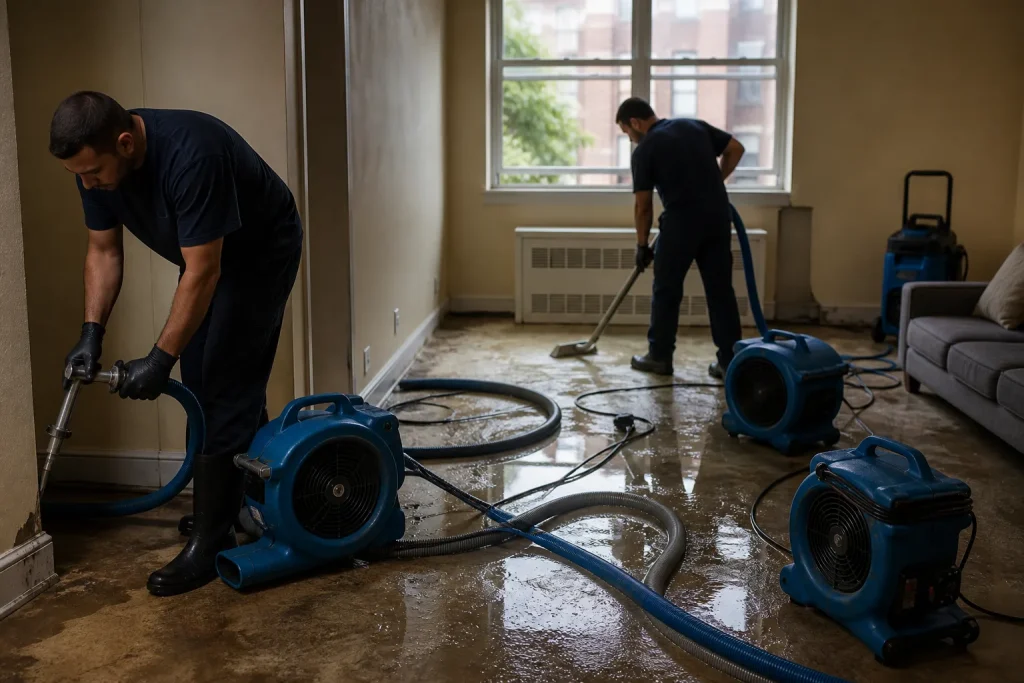
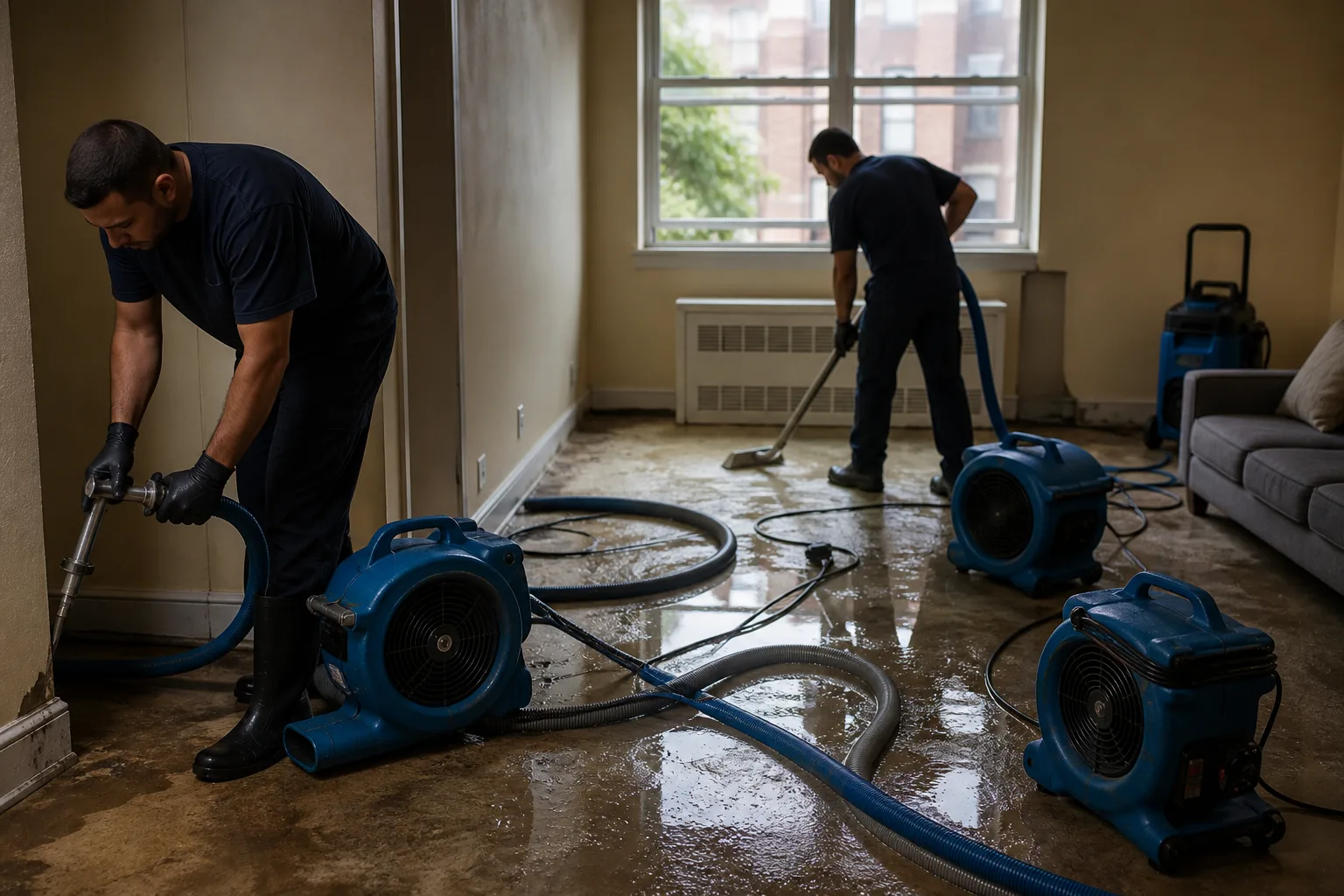
The equipment brands that keep showing up on our trucks are there for a reason. Dri-Eaz makes professional-grade dehumidifiers and air movers that perform differently than rental-store units. The difference shows up in your drying timeline.
A standard box fan and a consumer dehumidifier from a hardware store will eventually dry a minor spill, but a Category 2 loss inside a plaster wall in the East Bronx needs more grain depression per hour than standard equipment produces. Professional dehumidifiers pull more pints per day at lower temperatures, and calibrated air movers push 3,000-plus CFM where a rental unit pushes a quarter of that. The math changes whether your house dries in 5 days or 14, and every extra day is a mold risk.
Equipment is only as good as the monitoring behind it. A Dri-Eaz dehumidifier running in the wrong room does nothing. The psychrometric readings we discussed tell us where to place each air mover, when to add a second dehumidifier to the drying chamber, and when the dry standard is reached. That’s the difference between using good tools and delivering RIA-compliant results.
The Bottom Line
RIA water damage restoration in the East Bronx is not a slogan. It’s a documented process with measurable outputs: daily moisture readings, a dry standard, a final EMC number, and a written workmanship guarantee. The restorer who follows the standard will show you the log. The one who doesn’t will make you feel like you’re being difficult for asking.
If you’re in East Bronx and need help now, Floodline Restoration Co. home has been answering the phone with a live person 24/7 since 2010. We offer free estimates and direct insurance billing. Call (607) 602-2791 and we’ll walk the job with you. See our Water Damage Restoration in East Bronx page for more detail, or if the loss sat for more than a few days, read about Mold Remediation in East Bronx. If your loss started from fire or smoke, we also handle Fire & Smoke Damage Restoration in East Bronx with the same written guarantee.
Frequently Asked Questions
How do I verify that my restorer in the East Bronx is actually RIA or IICRC certified?
Check the IICRC public registry by entering the technician’s name or the company name. WRT, ASD, and AMRT are the three credentials relevant to water damage. If the restorer standing in your home can’t be found there, they are not certified, no matter what the business card says. Ask specifically for the lead tech’s full name and verify before they cut into your walls.
What is a moisture log, and is it really required for RIA-compliant water damage restoration?
A moisture log is a dated, room-by-room record of moisture readings taken with a penetrating meter, showing daily progress from first extraction to final dry standard. The RIA S500 standard requires this documentation. Every legitimate restorer keeps one. The issue in the East Bronx is that too many homeowners never see it. Demand a copy on the final day, and check the final EMC reading against the dry standard for your materials.
Why does water damage restoration take longer in an East Bronx rowhouse or co-op than in a suburban house?
Older Bronx buildings have construction details that slow drying: balloon-frame wall cavities that wick water vertically, plaster over wood lath that holds moisture longer than modern drywall, and shared party walls that require coordination with neighboring units. A restorer who sets drying timelines based on a suburban slab house will under-monitor the job. Plan for more equipment days and more daily readings in an attached Bronx building.
Will my insurance company accept the moisture log as proof of loss?
Yes, and this is where hiring a company that bills your carrier directly pays off. A complete moisture log with daily readings gives your adjuster exactly what they need to process a claim without back-and-forth. Look for a restorer who documents the loss with photos, logs, and a written scope, then sends it all to the insurance company themselves so you don’t end up as the messenger between two parties who should be talking to each other.
If you’re still deciding and want to compare services side by side, call (607) 602-2791 and we’ll tell you honestly what we’d recommend, even if it means a smaller job than you expected. Our standing offers apply to every job: $50 off any repair over $250, an $89 seasonal tune-up, and a 5% senior and veteran discount. Always.
Written by Curt Bowman, Owner at Floodline Restoration Co., serving East Bronx since 2010.
Need Damage Restoration Help?
Call Floodline Restoration Co. - licensed & insured, here with fast after-hours help in East Bronx.
(607) 602-2791